Effective loyalty programs are no longer just tools for retaining valuable customers and business partners. Loyalty program trends have become powerful engines for predicting demand. Accurate demand forecasting helps businesses reduce wastage, optimize inventory, improve revenue, and streamline supply chains, ensuring they are prepared for both peak and lean periods.
Modern B2C and B2B loyalty programs—including a well-designed channel loyalty program—go beyond rewards and retention; they collect critical insights on customer and channel partner behavior, purchase patterns, and seasonal preferences. By analyzing this data, businesses can anticipate buying trends, plan stock levels efficiently, and make smarter operational decisions.
In today’s market, where data-driven decision-making is essential for staying competitive, leveraging insights from loyalty platforms can provide a significant edge. With the right loyalty program, companies can transform raw transaction data into actionable predictions, ensuring they meet demand without overstocking or under-serving their customers.
1. Access to accurate data
Let’s face it; a whopping majority of businesses struggle to access relevant and accurate data. There are many studies to prove it. For instance, a study conducted by Harvard Business Review found that just three percent of companies that participated in the study had accurate data within an acceptable range. Another survey by MicroStrategy found that 90 percent of executives depend on others to make data-driven decisions. And a Gartner study found that just one in every five analytics-based initiatives will ever be successful.
All these stats are not only worrying but highlight the reason why a majority of businesses need to level up the way they collate and analyze data. You need accurate data to make accurate predictions. And that’s where a sophisticated loyalty platform like LoyaltyXpert can be extremely helpful. Our intuitive platform provides 100 percent accurate data and helps in making data-driven decisions.
Today, advanced loyalty platforms also integrate AI and machine learning (ML)-based analytics, which automatically detect patterns, forecast demand, and provide actionable insights. This ensures even greater prediction accuracy and helps businesses stay ahead of market trends.
2. Effective collection of zero-party and first-party data
A sophisticated loyalty platform not only provides access to accurate data but also facilitates the collection of zero-party and first-party data. Both types of data are regarded as the most reliable and accurate type. In the case of zero-party data, customers share their personal information willingly. A customer experience survey conducted by Genesys found that 39 percent of 5,000 participants were willing to share their data if they received some rewards, while 20 percent of the participants were interested in product discounts.
Zero-party and first-party data cover everything from the demographic details of customers and business partners to the purchase amount, time and frequency of the purchase, total interactions, as well as feedback and reviews. Both data types come in handy in making accurate demand forecasts and sales predictions.
Alongside collecting reliable data, it is essential to follow privacy-first practices, ensuring compliance with GDPR and CCPA regulations, secure data handling, and ethical use of customer and partner information. This not only builds trust but also ensures the loyalty program operates responsibly while generating accurate insights.
3. Identification of buying patterns and previous trends
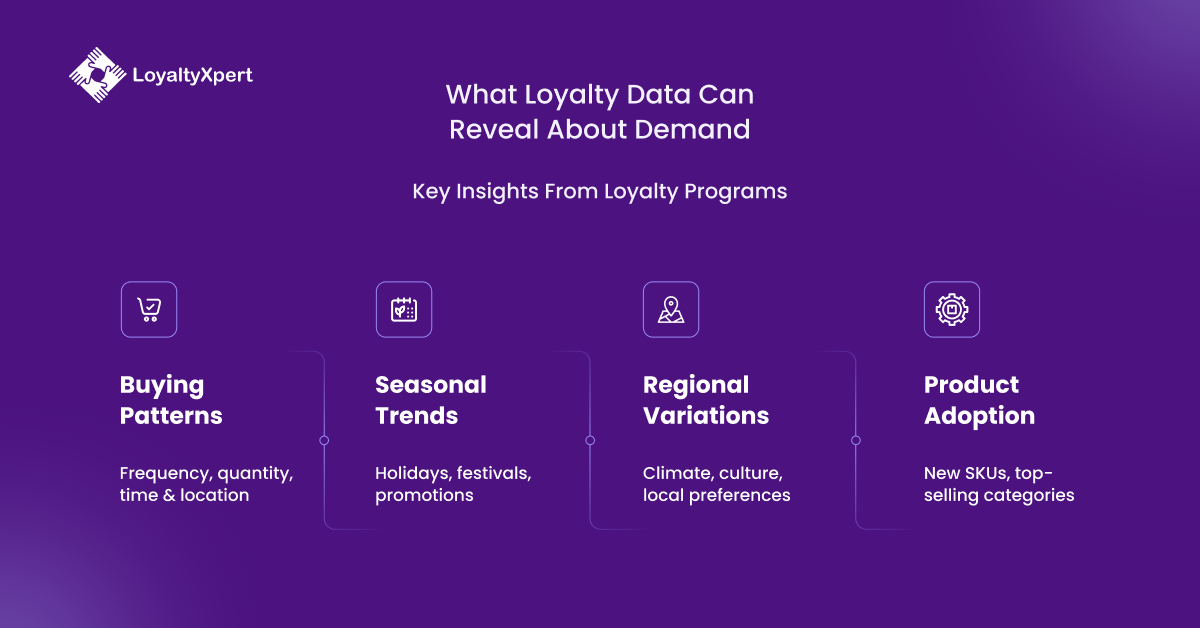
Data accessed and collected through loyalty programs provide a clear understanding of the buying patterns of customers and business partners. Apart from that, when customers and channel partners make a purchase and access loyalty points from their mobile devices, businesses can get the data of the location from where they bought the product, the day and time of the purchase, the quantity of the product, and much more information that helps in understanding buying patterns.
Apart from that, businesses can leverage loyalty programs to track and monitor user preferences, trends, and behaviors in real time. Past sales data can help in the projection of future demand. A cutting-edge loyalty platform can help in the efficient management and analysis of all critical data.
Businesses can now gain segmented insights, breaking down data by region, season, sales channel, or specific customer cohorts to better understand market behavior. Additionally, loyalty data can be used for trend prediction of new products, using historical buying patterns to forecast potential adoption and demand, helping companies plan launches and stock levels more accurately.
4. Seasonal, Promotional, and Geography-Based Demand Trends
Modern loyalty program trends show that businesses can do much more than track individual purchases—they can also predict demand fluctuations across different periods and regions. By analyzing loyalty data collected through app-based loyalty programs or other digital platforms, companies can identify patterns that directly impact inventory and supply chain planning.
Seasonal Peaks
Loyalty programs help businesses identify periods of high demand, such as festive seasons, holidays, or special occasions. Understanding when customers and channel partners are likely to make bulk purchases enables companies to stock adequately and avoid missed sales opportunities.
💡 Did you know?
Businesses using loyalty program data can predict seasonal demand spikes, helping them stock products just in time for peak buying periods.
Promotional Demand Spikes
Promotions, discounts, or limited-time offers often drive sudden surges in demand. Tracking how customers respond to these campaigns through loyalty software for business allows companies to forecast promotional demand more accurately and ensure sufficient product availability.
Regional Buying Variations
Customer behavior often differs by region due to cultural preferences, climate, or local trends. Loyalty programs provide insights into these variations, allowing companies to adjust their channel stocking strategies and meet regional demand efficiently.
💡 Did you know?
Loyalty programs don’t just track purchases—they can reveal regional buying trends, peak shopping days, and even product preferences, turning raw data into actionable forecasts.
By leveraging these insights, businesses can align production schedules, optimize warehouse inventory, and ensure smooth distribution across channels. Loyalty trends now emphasize predictive insights as a core function, helping loyalty program companies in India and globally to transform raw transaction data into actionable supply chain intelligence.
5. Data monitoring and report generation
By using an advanced loyalty platform, you can monitor all important data as well as generate a wide range of reports on various KPIs (key performance indicators). An effective loyalty program can also define trends based on various qualitative and quantitative data. You can also leverage demand planning tools and forecasting calculators to generate more precise forecasts.
Modern Enhancements: Today’s loyalty program trends include integration with demand planning tools, AI dashboards, and predictive analytics, which allow businesses to visualize trends in real time and make proactive, data-driven decisions. Additionally, advanced analytics in loyalty platforms help with fraud detection and error minimization, ensuring that loyalty data is accurate and reliable for operational and strategic planning.
6. Operational Impact of Predictive Insights
Predictive insights derived from loyalty data go far beyond understanding customer behavior—they directly influence business operations and efficiency. Here’s how:
- Production Planning: By analyzing buying patterns and seasonal trends from app-based loyalty programs, businesses can forecast demand more accurately, preventing both overproduction and stockouts.
- Supply Chain Optimization: Predictive insights help optimize logistics, ensuring timely replenishment of high-demand products and reducing unnecessary shipments.
- Warehouse Management: With accurate demand forecasts, companies can allocate storage efficiently, minimize holding costs, and prevent overstocking of low-demand items.
- Distributor Stocking: Understanding regional variations allows distributors to maintain the right inventory mix, improving service levels and reducing lost sales opportunities.
Overall, leveraging predictive loyalty data leads to reduced operational costs, better resource utilization, and improved efficiency, enabling businesses to meet customer expectations seamlessly. These benefits represent the latest loyalty program trends for companies that want to stay competitive.
7. Best Practices to Leverage Loyalty Programs for Demand Prediction
To maximize the potential of loyalty programs for predicting demand trends, businesses should follow these actionable best practices:
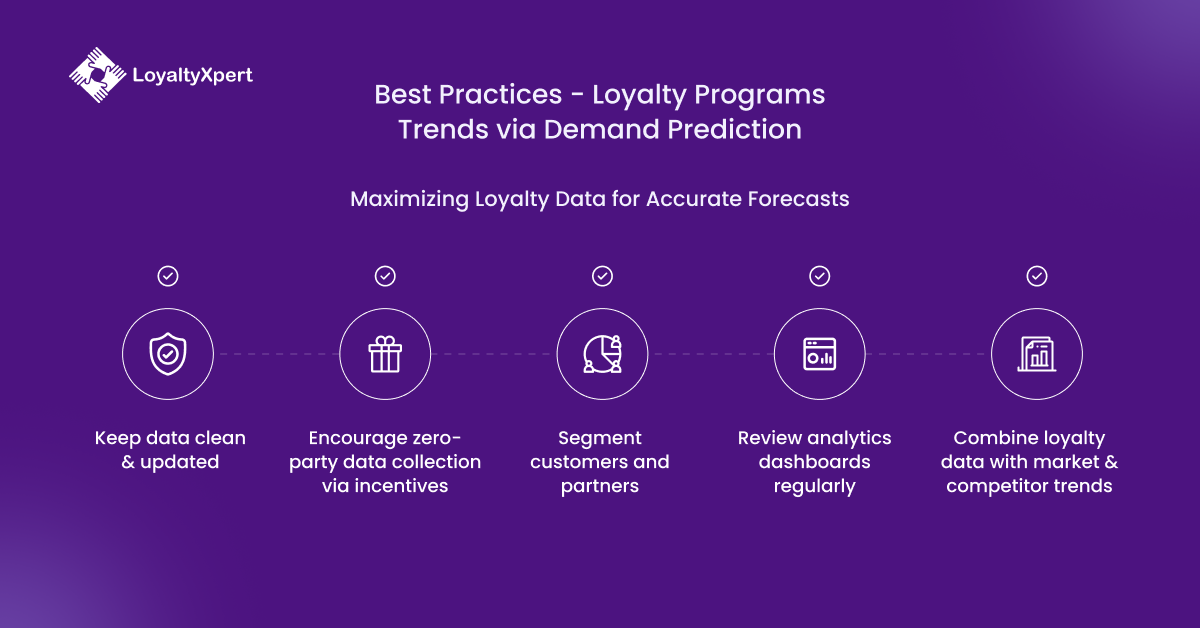
- Keep Data Clean and Updated: Ensure customer and partner information is accurate, complete, and timely for reliable forecasting.
- Encourage Zero-Party Data Collection Through Incentives: Use rewards to motivate customers to share preferences and intent, providing richer insights.
- Segment Customers and Partners: Divide your audience by purchase behavior, region, or channel to achieve more precise trend analysis.
No CTA found.
- Regularly Review Analytics Dashboards for Anomalies: Monitor for sudden changes or unusual patterns that could impact inventory and demand planning.
- Combine Loyalty Data with Market and Competitor Trends: Integrate external insights with internal loyalty data for holistic and actionable demand predictions.
Implementing these practices through loyalty software for business allows loyalty program companies in India and globally to leverage loyalty trends effectively for smarter operational decisions.
In a Nutshell
Modern loyalty programs are no longer limited to customer retention—they are essential tools for predicting demand trends and optimizing business operations. By combining accurate data, buying patterns, seasonal insights, and operational forecasts, companies can plan production, manage warehouses, and optimize supply chains with confidence.
The latest loyalty program trends emphasize predictive analytics, AI-driven insights, and app-based platforms, making it easier than ever for businesses to anticipate demand and make data-driven decisions. For loyalty program companies in India and beyond, leveraging these programs ensures a competitive edge in both customer engagement and operational efficiency.
To explore how your business can implement these advanced loyalty solutions, Contact Us Today or Get a Free Demo of LoyaltyXpert and start turning loyalty data into actionable business growth.