Summary
This blog explores how Channel Partner Programs in India will fundamentally change by 2027, shifting from incentive-led schemes to systems of governance and control. It highlights emerging trends such as auditable incentives, data-triggered rewards, role-based eligibility, regional logic, and tighter financial oversight. The blog explains why future-ready manufacturers will treat channel loyalty as core infrastructure—driving compliance, predictability, and controlled partner performance rather than just volume growth.
For most manufacturers, Channel Partner Programs were created to push volume, not to control outcomes. Incentives were treated as spend items, loyalty as a scheme, and partner behavior as something to be “managed” by the field.
That model is breaking down.
Today, manufacturers face a tougher reality: rising margin pressure, inconsistent pricing, audit scrutiny, and limited visibility into what partners actually do after incentives are paid. In this environment, Channel Partner Programs in India are no longer just about rewards; they are becoming systems of governance.
This is why forward-looking manufacturers are rethinking how they define a channel partner, how rewards are triggered, and how loyalty is measured. The question is no longer how to motivate partners, but how to create predictable, compliant, and controllable partner performance.

This blog looks ahead to 2027, not to speculate, but to highlight the structural changes already underway in Channel Partner Programs. The kind of changes that will separate manufacturers who control their channels from those who simply fund them.
1. Channel Partner Programs Will Move From Marketing Spend to Financial Control
Traditionally, channel incentives sat inside marketing or sales budgets. Success was measured by activities such as schemes launched, points issued, and campaigns completed. By 2027, that mindset will no longer survive. Leading manufacturers are already repositioning channel partner programs as financial levers, not promotional tools.
What’s changing:
- Loyalty budgets are now reviewed alongside trade spend
Incentives are being compared with discounts, rebates, and margins, not isolated as “marketing costs.”
Every incentive must answer one question. Reward issued, Partner behavior, Revenue or margin impact.
- Channel Partner Programs become control mechanisms
They help regulate pricing discipline, product focus, and partner prioritization, not just push volume.
This shift is pushing companies toward structured loyalty management platforms that can link incentives directly to business outcomes, rather than fragmented spreadsheets or manual approvals.
? Did you know?
Most channel partner programs were originally designed to distribute incentives—not to enforce pricing, compliance, or partner behavior.
2. Incentives Will Be Auditable Inside Loyalty Management Platforms
One of the biggest risks in legacy channel partner programs is opacity.
Manual overrides, ad-hoc payouts, and offline settlements may feel flexible, but they increase compliance risk, disputes, and internal mistrust. By 2027, this approach will be unacceptable for most mid-to-large manufacturers. Modern loyalty program software is already embedding governance into incentive execution.
What auditable channel partner programs will include?
- Rule-based reward engines
Incentives are triggered only when predefined conditions are met, no ambiguity, no favoritism.
- Approval workflows and audit trails
Every reward, exception, or correction is logged with time stamps and authorization history.
Points issued, rewards redeemed, and payouts aligned with financial systems.
Finance, sales, and leadership see the same numbers, reducing conflict and surprise escalations.
As governance becomes non-negotiable, manufacturers will increasingly rely on channel partner loyalty software and structured channel partner reward platforms to protect both margins and credibility.
By 2027, incentives won’t just motivate partners, but they will stand up to audits, reviews, and board-level scrutiny.
3. Channel Partner Rewards Will Be Triggered by Data, Not Declarations
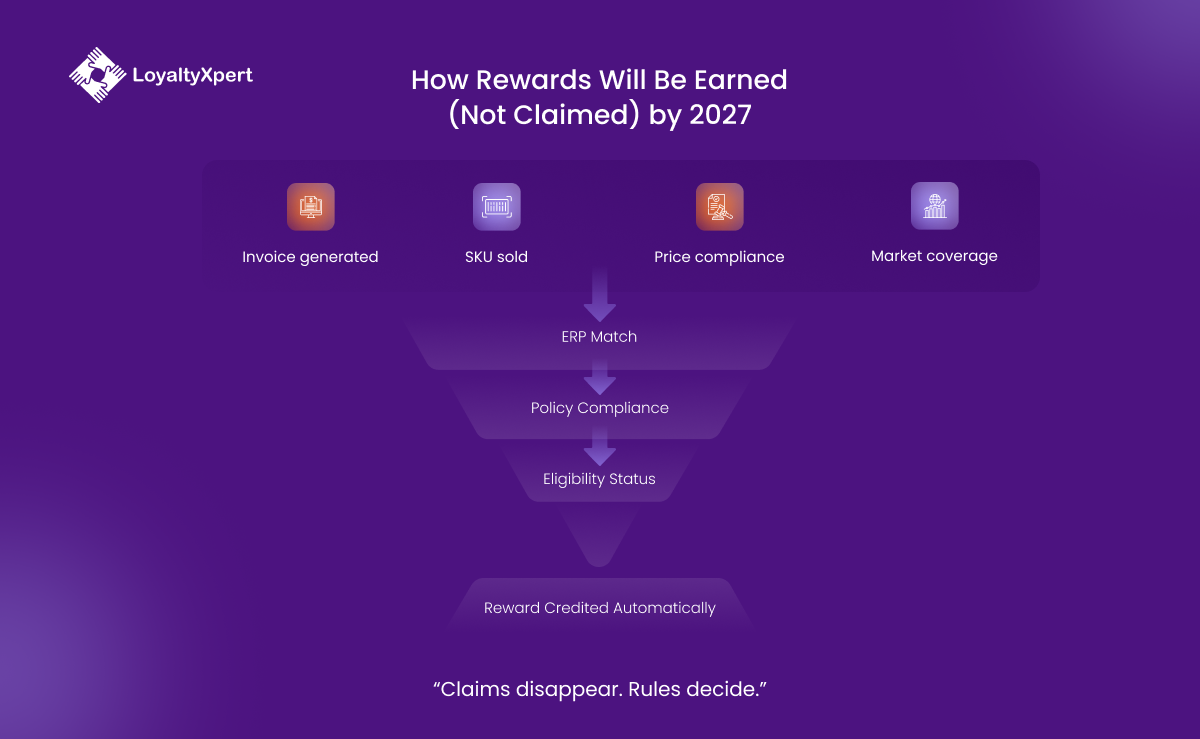
For decades, most channel incentives were built on trust and paperwork. Partners declared sales, claims were submitted, and rewards were processed weeks or months later. In today’s environment, that model is fragile and expensive. By 2027, high-impact Channel Partner Programs will no longer rely on self-reported numbers. Manufacturers are already moving toward data-triggered rewards, where incentives are released only when verified business signals are captured.
What’s driving this shift?
- Self-reported claims are losing credibility
Disputes, over-claims, and delayed reconciliations create friction between the brand and the channel partner.
- ERP-aligned primary sales data
Incentives are linked directly to invoices, dispatches, and billing systems.
- Secondary sales and market feeds
Visibility into dealer-to-retailer or retailer-to-customer movement improves accuracy and control.
- Reduced leakage and faster settlements
A structured channel partner reward platform eliminates manual checks and subjective approvals.
Modern channel partner loyalty software connects ERP, distributor systems, and field data into a single loyalty management platform. The result is fewer disputes, faster reward cycles, and stronger trust across Channel Partner Programs in India.
Rewards stop being “claimed.” They start being earned automatically.
4. Enrollment Will Matter Less Than Ongoing Partner Eligibility
Historically, the definition of what is a channel partner was simple: sign up, enroll, and stay in the program indefinitely. That approach inflated partner counts, but weakened performance.
By 2027, this will change fundamentally. Future-ready Channel Partner Programs will focus less on how many partners enroll and more on who remains eligible.
What will eligibility be based on?
Partners must submit timely, accurate data to remain active in the program.
- Commercial and policy compliance
Pricing discipline, scheme adherence, and ethical selling behavior become measurable criteria.
Participation in training, app usage, and digital adoption through an app-based loyalty program.
Not just volume, but quality of growth over time.
This shift makes loyalty conditional, not automatic. High-performing, compliant partners are rewarded more meaningfully, while inactive or non-compliant ones gradually lose benefits.
For manufacturers, this creates healthier ecosystems. For partners, it sets clear expectations. And for loyalty program companies in India, it marks the move from mass enrollment to managed partner networks powered by modern loyalty program software. By 2027, loyalty won’t be about being inside the program. It will be about earning the right to stay in it.
? Did you know?
Channel partners engage more consistently when they understand why a reward was earned, not just what was earned.
5. Rewards Programs for Channel Partners Will Enforce Policy
Today, incentives already shape how a channel partner behaves—what they push, which SKUs they prioritize, and how aggressively they discount. The difference is that this influence is mostly informal, inconsistent, and hard to control. By 2027, rewards programs for channel partners will move from influence to enforcement. Manufacturers are beginning to encode commercial policy directly into their Channel Partner Programs, turning loyalty into a governance layer.
What this look like in practice?
- Price discipline built into rewards
Partners earn incentives only when transactions stay within approved price bands.
- SKU and portfolio alignment
Strategic products, slow-moving lines, or new launches carry higher reward weightage.
Incentives linked to expanding reach, activating new outlets, or servicing underserved geographies.
- Reduced dependence on field negotiation
Rules are set once in the system, not reinterpreted on every sales call.
Modern channel partner reward platforms and loyalty management platforms make this possible through rule-based logic, approvals, and audit trails. As a result, Channel Partner Programs in India stop being reactive schemes and start acting as structured policy tools—without constant manual intervention.
Loyalty no longer just rewards outcomes. It quietly enforces the rules behind them.
6. Regional Logic Will Be Hard-Coded Into Channel Partner Programs in India
India does not operate as one market, and neither can loyalty.
Yet many Channel Partner Programs in India still run on a single national slab structure. The result is predictable: field-level exceptions, negotiation fatigue, and uneven performance across regions. By 2027, this one-size-fits-all approach will disappear. Future-ready programs will hard-code regional logic directly into the channel partner loyalty software, removing ambiguity and inconsistency.
No CTA found.
What will change?
- Region-wise incentive rules
Different reward thresholds for metro, tier-2, and rural markets.
- Market maturity-based logic
Emerging regions rewarded for activation and coverage, mature markets for depth and efficiency.
- Localized reward catalogs
Incentives that reflect regional preferences and operational realities.
Clear rules reduce disputes between sales teams, partners, and management.
With modern loyalty program software and app-based loyalty programs, manufacturers can manage complexity without adding chaos. For loyalty program companies in India, this marks a shift toward precision-driven loyalty systems that scale across geographies.
By 2027, regional alignment won’t be managed by people and exceptions. It will be built into the system by design.
7. Reward Catalogs Will Shrink as Control Increases
For years, bigger reward catalogs were seen as better loyalty. More choices, more excitement, more motivation. In reality, large catalogs often created the opposite effect—confusion, delayed fulfillment, and reconciliation headaches. By 2027, Channel Partner Programs will move away from excess and toward control. Manufacturers are realizing that loyalty works best when rewards are predictable, compliant, and easy to manage.
What’s changing inside modern channel partner loyalty software?
- Smaller, curated reward catalogs
Fewer options that partners actually value and redeem.
- Lower fulfillment and financial risk
Reduced leakage, faster settlement, and cleaner accounting.
- Standardized rewards across regions and tiers
Easier governance without constant exceptions.
- Focus on consistency over novelty
Trust grows when partners know rewards will arrive on time, every time.
For rewards program for channel partners, optimization is replacing excitement. The goal is not to impress, but to perform. This shift is being driven by manufacturers who want loyalty systems that scale without operational friction, supported by reliable loyalty management platforms and loyalty program software.
8. App-Based Loyalty Programs Will Become Partner Control Interfaces
The future app-based loyalty program is no longer just a place to check points or redeem rewards. By 2027, it will become the primary interface through which a channel partner understands the business relationship. In many Channel Partner Programs in India, the app is evolving into a daily decision-support tool.
How will partners use it?
- Track performance in real time
Sales progress, target achievement, and reward eligibility are clearly visible.
- Understand how incentives are calculated
No guesswork, no disputes. Rules and logic are transparent.
- See compliance and qualification status
Eligibility is earned and maintained, not assumed.
- Plan actions to improve rewards
The app shows what to do next, not just what happened last month.
This shift is redefining what is a channel partner relationship. Loyalty apps are no longer engagement tools alone; they are control and communication layers powered by robust channel partner reward platforms.
For manufacturers and loyalty program companies in India, transparency becomes a powerful retention lever. When partners trust the system, they stay aligned without constant follow-ups or escalations. By 2027, loyalty apps won’t just reward behavior. They’ll explain it.
9. Loyalty Program Companies in India Will Be Evaluated on Governance, Not Features
For a long time, buying loyalty technology meant comparing feature lists. More dashboards. More gamification. Bigger catalogs. That mindset is already fading. By 2027, loyalty program companies in India will be judged less on how many features they offer, and more on how well they help manufacturers stay in control.
As Channel Partner Programs mature, executive teams are asking harder questions like Can we trust the data? Can we audit incentives? Can this scale without breaking processes?
What manufacturers will evaluate instead?
- Data integrity and accuracy
Incentives must be based on verified transactions, not assumptions.
- Compliance and audit readiness
Every reward, approval, and exception should leave a clear trail.
- Scalability across complex channel structures
Distributors, dealers, and retailers must coexist in one governed system.
- Stability over experimentation
CFOs and auditors prefer reliability to feature overload.
Feature-heavy platforms may look impressive in demos, but governance-ready channel partner loyalty software earns long-term trust. This is why rewards programs for channel partners are increasingly built on enterprise-grade loyalty program software, not lightweight tools.
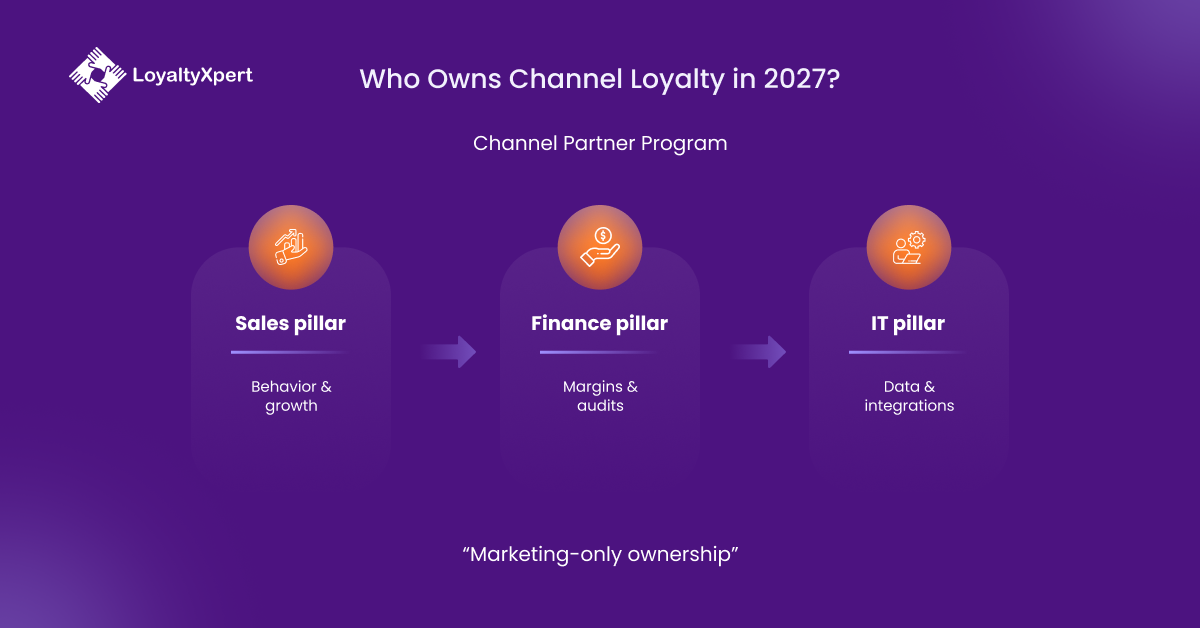
10. Channel Partner Programs Will Sit Across Sales, Finance & IT
One of the biggest shifts ahead has nothing to do with technology and everything to do with ownership. Traditionally, Channel Partner Programs in India lived inside sales or marketing. By 2027, that model no longer holds.
Modern Channel Partner Programs now influence:
- revenue realization
- pricing discipline
- compliance exposure
- partner eligibility
As a result, ownership is becoming shared.
What this look like in practice?
- Sales defines behavior and growth objectives
What partners should sell, where, and how.
- Finance controls incentive logic and payouts
Ensuring margins, auditability, and budget discipline.
- IT manages integrations and data flows
ERP, CRM, POS, and partner apps working as one system.
This is where the loyalty management platform becomes core infrastructure, not a campaign tool. The app-based loyalty program becomes a front-end, while governance and data logic run deep in the system. In the future, Channel Partner Programs will be reviewed the same way revenue systems are reviewed for control, predictability, and resilience. Not for how exciting they look, but for how reliably they run.
Conclusion
The real shift ahead is not about more rewards or flashy technology. It is about discipline, predictability, and control.
By 2027, Channel Partner Programs will function as governance systems, not promotional schemes. Manufacturers who modernize early will gain better visibility, stronger compliance, and tighter alignment across distributors, dealers, and retailers. Those who don’t will continue running fragmented rewards programs, facing leakage, disputes, and limited control.
This is where LoyaltyXpert plays a critical role. Designed for complex Channel Partner Programs in India, LoyaltyXpert helps manufacturers move from manual incentives to structured, auditable, and data-driven loyalty management. It brings transparency, scalability, and accountability into one unified platform.
If you’re planning the future of your channel strategy, now is the time to act. Contact us to discuss your channel challenges, or request a free demo to see how LoyaltyXpert helps manufacturers take control of their Channel Partner Programs before the market decides for them.