[key_highlights]
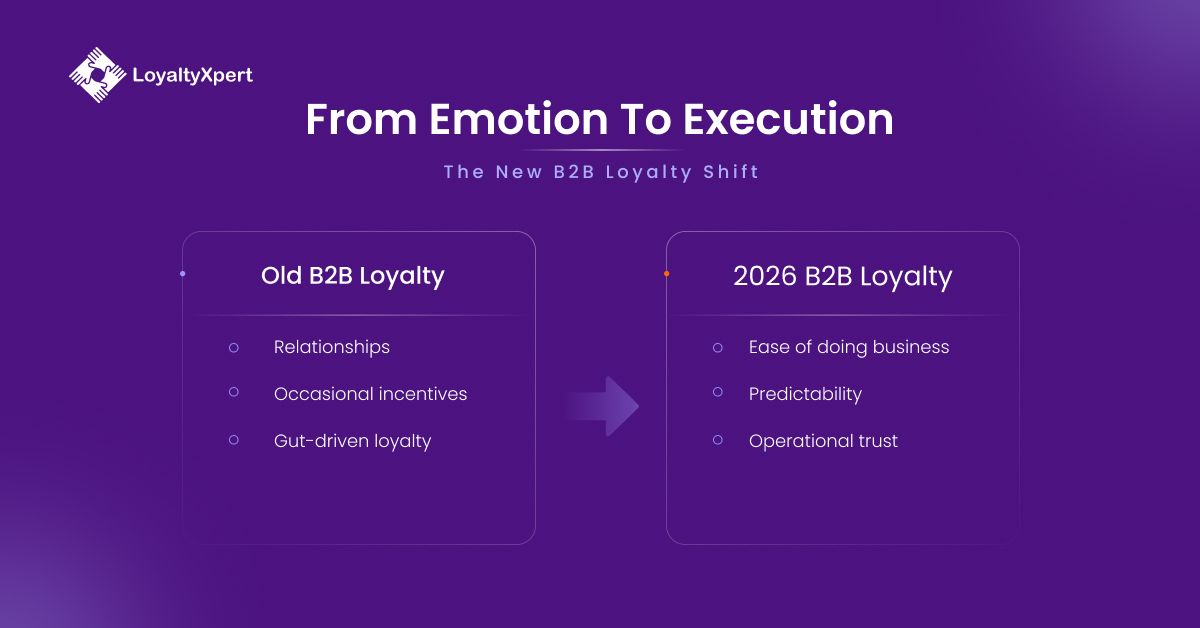
B2B buying has changed quietly, but fundamentally. Today’s buyers are under pressure to deliver efficiency, control costs, and reduce risk. Loyalty is no longer driven by long relationships or brand sentiment alone.
This shift is redefining B2B loyalty programs. In 2026, loyalty is less about how buyers feel and more about how smoothly business gets done.
Modern B2B loyalty is driven by:
Buyers stay loyal to partners who simplify ordering, billing, and engagement instead of adding complexity.
- Predictability and consistency
Stable pricing, clear rules, and reliable outcomes matter more than occasional high-value rewards.
When processes work without friction, buyers behave loyally, even if they don’t consciously think of it as loyalty.
The most successful B2B loyalty programs today reinforce these behaviors. They support repeat purchases, reduce switching, and embed the brand deeper into daily operations. This is why B2B organizations are investing in structured loyalty frameworks instead of ad-hoc incentives.
In short, buyers may not feel loyal anymore, but they act loyal when the system works.
1. Who B2B Loyalty Programs Are Really Built For?
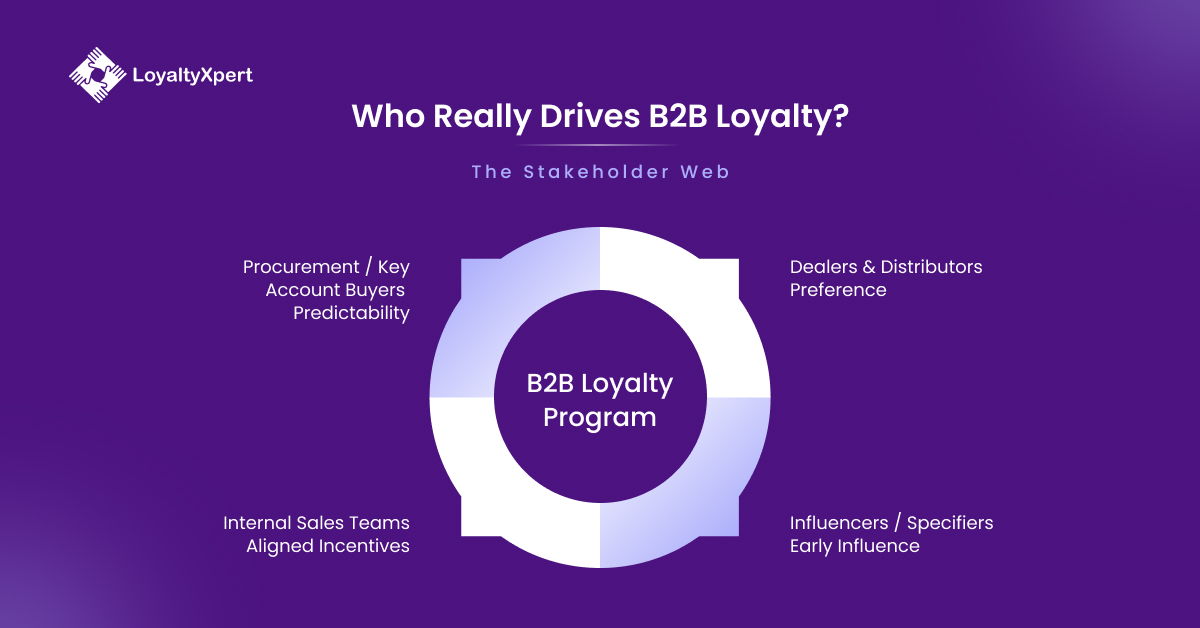
B2B loyalty is rarely about a single audience. Successful programs recognize that buying decisions are influenced by multiple stakeholders across the value chain.
A well-designed B2B loyalty program strategy accounts for each of these groups.
Key account buyers
- These include procurement heads and purchasing managers. They value long-term benefits such as preferential pricing, priority access, and predictable rewards through a structured B2B loyalty rewards program.
Dealers, Distributors & Channel Partners
- Channel partners influence visibility, recommendations, and sell-out. Loyalty programs for them are designed to drive commitment, drive brand switching, and improve market coverage.
Influencers and Brand Advocates
- Consultants, architects, engineers, and advisors may not buy directly, but they shape final decisions. Including them strengthens brand advocacy early in the buying cycle.
Internal sales teams and field staff
- Many programs overlap with sales incentives and SPIFs. When internal and external incentives align, execution becomes faster and more consistent.
Managing these diverse participants manually is nearly impossible at scale. This is why companies increasingly rely on b2b loyalty program software, app-based brand loyalty programs, and a centralized loyalty management platform to ensure fairness, transparency, and control.
In 2026, B2B loyalty programs succeed not by targeting everyone equally, but by engaging the right stakeholders in the right way.
2. The Shift from Incentives to Ecosystems
Many B2B organizations still treat loyalty as a collection of incentives, such as running a scheme, pushing rewards, close the quarter. That approach no longer holds.
In 2026, B2B loyalty programs are evaluated as ecosystems, not campaigns.
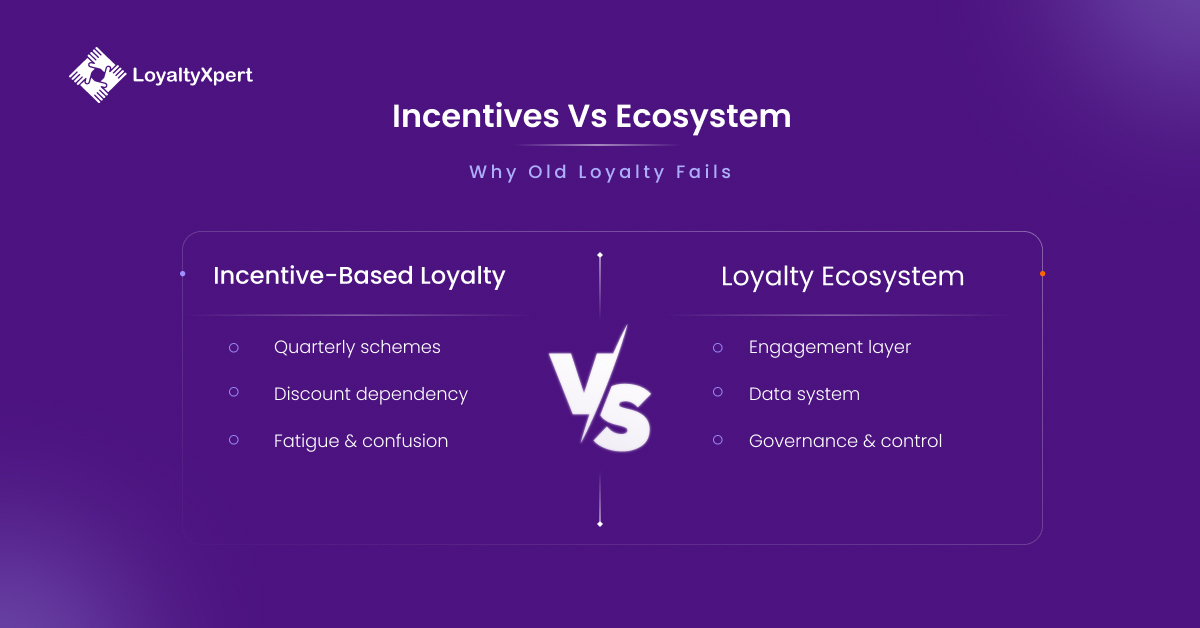
A modern loyalty ecosystem plays three roles at once:
It creates structured, ongoing interactions with buyers, dealers, and partners, beyond transactions.
Every action, claim, and reward generates insights into behavior, performance, and preference. This data becomes more valuable than the reward itself.
Loyalty platforms now help organizations enforce rules, ensure fairness, and reduce disputes across complex partner networks.
Isolated incentives fail because they don’t compound value. They drive short-term spikes but create long-term fatigue, confusion, and dependency on discounts. In contrast, successful B2B loyalty programs are designed to strengthen relationships, improve visibility, and support decision-making across sales, finance, and operations.
This is why enterprises increasingly invest in structured loyalty management platforms instead of running fragmented incentive schemes.
3. Structural Models of B2B Loyalty Platforms
Before choosing rewards or technology, manufacturers and B2B brands must decide how loyalty should work structurally. The most effective B2B loyalty program strategy is built on the right model.
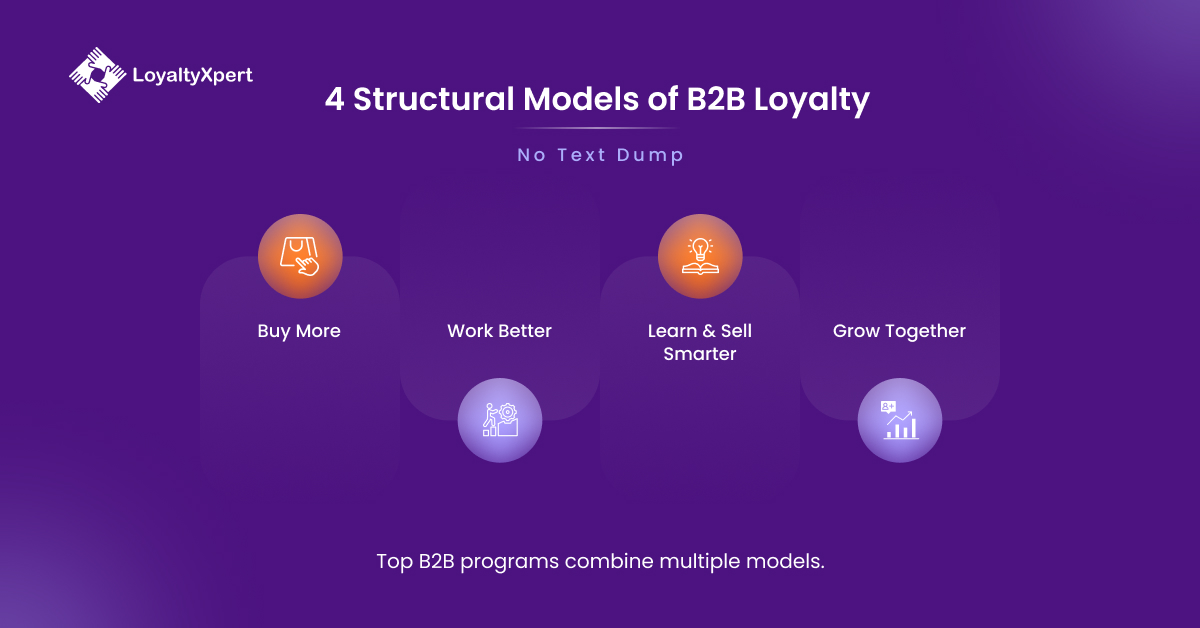
Common structural models include:
Rewards are tied to purchases, order value, or frequency. This model works well for driving repeat buying but must be carefully designed to avoid margin erosion.
Partners are rewarded for actions such as product adoption, data sharing, market development, or digital engagement. This shifts focus from “how much you buy” to “how you work with us.”
Loyalty is built through training, certifications, and skill development. This model strengthens product knowledge, improves execution, and reduces dependency on price-based incentives.
Designed for strategic partners, this model emphasizes long-term benefits like exclusivity, joint planning, and revenue growth rather than transactional rewards.
Most top B2B loyalty programs combine multiple models. Managing these hybrid structures at scale requires robust b2b loyalty program software that can handle rules, eligibility, and multi-stakeholder participation without manual intervention.
4. Designing B2B Rewards That Align With Business Outcomes
In B2B, rewards are not about excitement; they are about alignment.
Well-designed B2B loyalty rewards redemption programs reinforce the behaviors that protect margins, improve predictability, and strengthen partnerships. Poorly designed rewards, however, can inflate costs without improving loyalty.
Key principles for outcome-aligned reward design include:
- Reward margin, not just volume
Incentives tied only to sales volume often encourage discount-driven behavior. Mature programs reward profitable growth instead.
- Balance short-term and long-term incentives
Short-term rewards drive action, but long-term benefits drive commitment. Successful programs use both, clearly defined within the loyalty structure.
Rewards should benefit both the business and the participant, whether through better planning, reduced friction, or capability improvement.
- Make rewards transparent and predictable
Partners engage more when they understand exactly how rewards are earned and redeemed, especially through app-based loyalty programs.
Answering questions like “how much does a b2b loyalty program cost?” depends heavily on this alignment. Programs that focus only on payouts are expensive. Programs that focus on outcomes become self-sustaining.
This strategic approach is what separates tactical incentives from truly scalable B2B loyalty programs.
💡 Did you know?
In B2B, over 70% of buying decisions are influenced by ease of doing business, not brand preference or relationship history.
5. Program Governance: Rules, Eligibility & Control
One of the fastest ways B2B loyalty programs fail is not because of weak rewards, but because of weak governance.
As programs scale, questions start surfacing from every direction. Who is eligible? Why was this reward approved? Why was that claim rejected? Without clear governance, loyalty becomes a source of friction instead of trust.
Strong governance in a b2b loyalty strategies starts with structure:
- Eligibility-based participation
Not every partner, buyer, or reseller should automatically qualify. Clear eligibility rules protect program integrity based on role, region, performance, or tenure.
- Partner validation mechanisms
Dealer, distributor, or influencer validation ensures rewards go to the right participants, reducing misuse and duplicate claims.
Automated or rule-driven approvals reduce manual intervention while still allowing exceptions where needed.
- Role-based access controls
Sales, finance, and operations teams each see only what they need, improving accountability without slowing execution.
This level of governance is why modern b2b loyalty program software is no longer optional. It allows organizations to scale loyalty confidently, without losing control.
6. Operational Execution of Loyalty Programme to Scale
Designing loyalty is one challenge. Running it smoothly, quarter after quarter, is another.
In reality, successful B2B loyalty programs operate across geographies, partner tiers, and evolving business priorities. Execution breaks down when programs are rigid or overly manual.
Operationally strong programs focus on:
- Multi-region and multi-market readiness
Loyalty structures must adapt to regional policies, tax rules, and partner expectations without reinventing the program each time.
- Distributor- dealer hierarchy management
Clear logic is needed to handle layered relationships, avoid conflicts, and ensure rewards flow correctly across the channel.
- Program updates without disruption
Whether it’s a new incentive, rule change, or reward refresh, updates should not halt ongoing participation.
- Change management and communication
Partners disengage when rules change silently. Clear communication keeps trust intact.
This is where a scalable loyalty management platform quietly does the heavy lifting, ensuring programs run consistently while the business continues to evolve.
💡 Did you know?
High-performing B2B loyalty programs are reviewed as business relationships, not marketing campaigns.
7. Data as the Backbone of Modern B2B Loyalty
In 2026, loyalty decisions are no longer driven by instinct or end-of-quarter reports. They are driven by data, and more importantly, by the right data.
Modern B2B loyalty programs are expected to answer questions beyond “how much was sold.”
What matters now?
- Sell-in vs sell-out clarity
Understanding what moves into the channel versus what actually moves out helps prevent over-incentivization and channel stuffing.
- Behavior visibility beyond sales
Training participation, product adoption, and engagement patterns often predict long-term loyalty better than revenue alone.
- Trust through transparency for loyal partners
When partners can see their performance, rewards, and status in real time, often via an app-based loyalty program, disputes reduce and engagement improves.
- Insight for better account-based marketing
The goal isn’t dashboards. It’s clarity that helps leaders refine incentives, control costs, and answer questions like “how much does a b2b loyalty program cost?” with confidence.
This is why advanced loyalty program software has become central to loyalty success, not as a reporting tool, but as a decision engine.
8. B2B Loyalty Programs Across Industries: What Changes, What Doesn’t?
While the structure of B2B loyalty programs remains consistent, their execution looks very different across industries. What works in manufacturing may fail in SaaS, and what motivates distributors may not move high-value enterprise buyers. Understanding these nuances is critical to building a program that actually performs.
- Manufacturing-led businesses
Loyalty here is deeply tied to volume, continuity, and channel relationships. Programs often focus on dealers, distributors, and influencers, with incentives linked to product mix, training participation, and sell-out performance. Governance and eligibility matter more than flashy rewards.
- Distribution-heavy models
In distribution, loyalty success depends on visibility and fairness. Partners expect transparent rules, fast reward validation, and minimal disputes. Strong b2b loyalty program software helps manage complex hierarchies without manual intervention.
- SaaS and service businesses
Loyalty shifts toward renewals, usage behavior, and advocacy. Right rewards often support long-term engagement rather than short-term transactions, making data and behavior tracking central to the b2b loyalty program strategy.
- High-volume vs high-value sales
High-volume environments prioritize automation and scalability, while high-value sales demand precision, personalization, and tighter controls. Regardless of the model, the most successful B2B loyalty programs balance flexibility with discipline.
What doesn’t change across industries is the need for clarity, trust, and systems that scale without friction, something modern loyalty management platforms are designed to support.
9. Putting It All Together
As B2B buying continues to evolve, loyalty is no longer driven by emotion or occasional incentives. It is shaped by consistency, ease of doing business, and trust in how programs are governed and executed. The most effective B2B loyalty programs are those that behave less like short-term schemes and more like long-term business systems.
What ultimately sets strong programs apart is their ability to scale without confusion, adapt without disruption, and deliver predictable outcomes for all stakeholders. Programs that age well prioritize structure over noise, transparency over complexity, and alignment over experimentation. They reduce internal friction, limit disputes, and give partners a clear reason to stay engaged year after year.
This is where experience and platform capability begin to matter. Organizations that work with partners like LoyaltyXpert typically focus on building loyalty ecosystems that are governed, measurable, and future-ready, designed to support growth rather than constantly defend decisions. When loyalty becomes easier to run and easier to trust, it starts delivering value well beyond rewards.
If you’re evaluating how to strengthen or modernize your B2B loyalty approach, a focused discussion or a quick product walkthrough can help clarify what’s possible. You can contact us to explore your use case or request a demo to see how a scalable loyalty framework can fit into your business without overhauling everything at once.