Retaining the right audience is no longer optional, but a growth necessity. This is why understanding the difference between a B2B Loyalty Programs and a B2C Loyalty Programs is critical for businesses planning long-term customer retention strategies. While both aim to drive repeat engagement, they are built for very different buying behaviors, decision cycles, and reward expectations.
A B2B Loyalty Program focuses on retaining business clients such as dealers, distributors, channel partners, and enterprise buyers through value-driven and relationship-based incentives. In contrast, a B2C Loyalty Program is designed to retain individual consumers by offering personalized rewards, convenience, and emotional engagement. These differences directly shape B2B vs B2C customer retention approaches.
In 2025, digital transformation has further widened this gap. The adoption of B2B loyalty program software and B2C loyalty program software, along with data analytics and app-based engagement, has redefined how B2B reward programs and B2C reward programs are designed and scaled. This blog explores the 12 major differences you need to know before choosing the right loyalty strategy.
B2B Loyalty Program vs B2C Loyalty Program
1. Target market and scale
With fewer numbers of potential clients, the target market for B2B companies is small and focused. With a large number of prospective buyers, the target market for B2C vendors is massive. Apart from the target market, the next difference is the scale. B2B loyalty programs tend to be small in scale, whereas B2C loyalty programs tend to be much larger in scale.
2. Need of Buyers
Buyer expectations vary widely between a B2B Loyalty Program and a B2C Loyalty Program. In B2B transactions, clients seek expertise, reliability, and long-term business value. Loyalty is driven by structured B2B reward programs that support growth, profitability, and operational efficiency rather than emotional appeal. In contrast, B2C buyers look for convenience, instant rewards, and personalized experiences. B2C customer loyalty programs focus on emotional engagement through tailored offers and quick benefits. With rising digital expectations, both models now rely on advanced b2b loyalty program software and b2c loyalty program software to deliver relevant, personalized loyalty experiences and improve B2B vs B2C customer retention.
3. Volume of purchases
Another big difference between B2B transactions and B2C transactions is the volume of purchases. In the former, the volume of purchases is massive as many people in an organization use the products. This results in more frequent purchases that are huge in volume. In the latter, the purchases are small as the customers buy the products or services to use on their own or with their family members.
4. Buying cycle
B2B companies have a longer buying cycle as they are more planned and focused when it comes to buying a product. As per a study, the B2B buying process is becoming longer and more complex as the majority of buyers are taking a lot of time to research and make business decisions. The companies don’t want to make the wrong purchasing decisions, and many want to maintain a long-term relationship with their vendors.
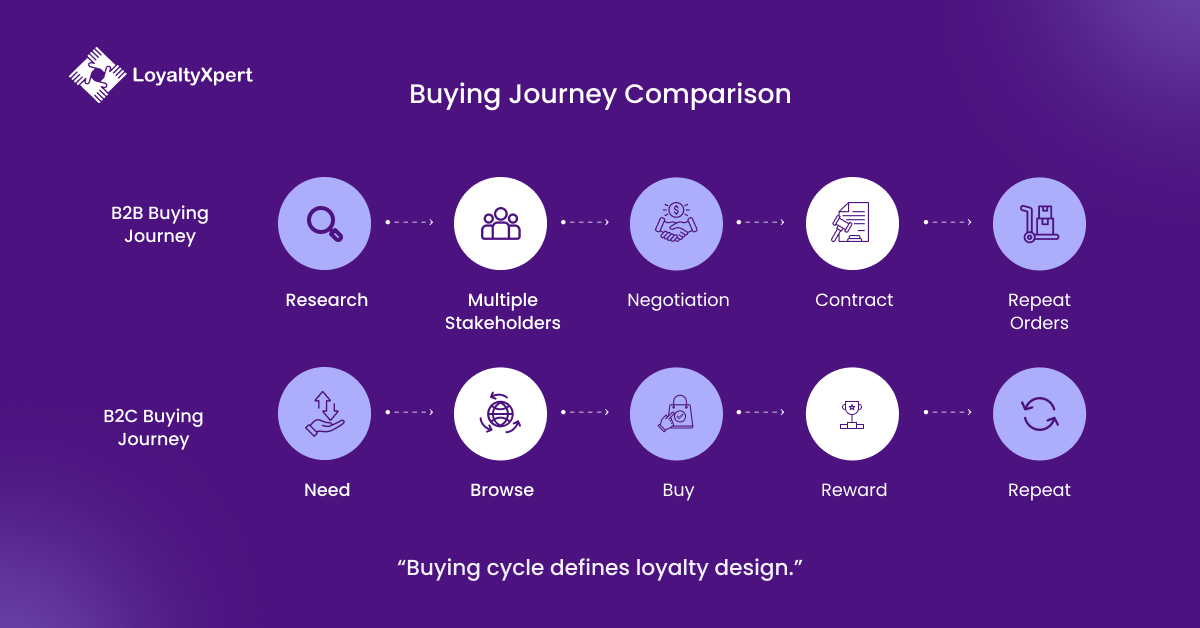
In B2C, however, the buying cycle is short as most of the customers take relatively less time on research and evaluation before purchasing the products and services they need. The buying cycle also affects the transaction time. In a B2B loyalty program, transactions take a longer amount of time. In a B2C loyalty program, transactions are faster and take less time.
5. Relationship and Communication
Relationship depth and communication style vary greatly between a B2B Loyalty Program and a B2C Loyalty Program. In B2B, loyalty is built on long-term relationships between vendors and business clients. Regular communication, trust, and collaboration are critical, often supported through dedicated portals, CRM integrations, and automated engagement using b2b loyalty program software.
In B2C, personal relationships are limited, and loyalty depends more on product value and experience. Communication is largely digital—through mobile apps, emails, push notifications, and automated campaigns. B2C customer loyalty programs focus on delivering timely rewards and offers rather than relationship-led interactions.
6. Focus
The focus of B2B customer loyalty programs is primarily on account growth, repeat business, and cross-sell or upsell opportunities. Programs are designed to strengthen partnerships and increase wallet share using data-driven insights.
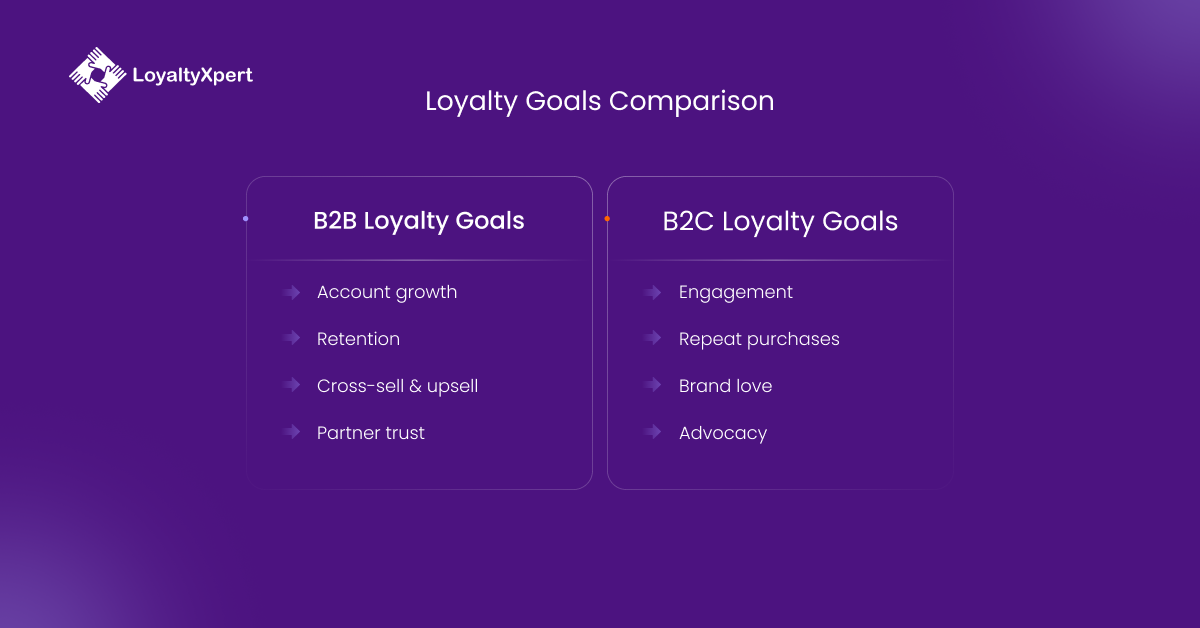
In contrast, B2C loyalty programs focus on brand building, customer engagement, and repeat purchases. Powered by b2c loyalty program software, these programs rely heavily on customer data and analytics to personalize offers, improve retention, and influence buying behavior—making B2B vs B2C customer retention strategies fundamentally different.
7. Reward achievement
Businesses have huge purchasing power compared to individual customers. The former outspends the latter by a huge margin. Corporate clients spend much more than individual customers and earn a large number of rewards every year. In B2B loyalty programs, the potential to achieve huge rewards is much higher compared to B2C loyalty programs.
💡 Fun Fact
B2B loyalty programs reward business growth, while B2C loyalty programs reward behavior and emotion; that’s why their reward structures look completely different.
8. Membership
The membership in B2B and B2C loyalty programs is vastly different. In the former, clients must make a purchase or sign a contract to join. In the latter, members join for free, and they receive immediate rewards.
9. Offers and Rewards
A B2B Loyalty Program focuses on long-term, business-driven rewards such as growth incentives, training support, and exclusive partner benefits. With modern b2b loyalty program software, rewards are increasingly delivered through digital channels like tier badges, QR-based tracking, and app notifications.
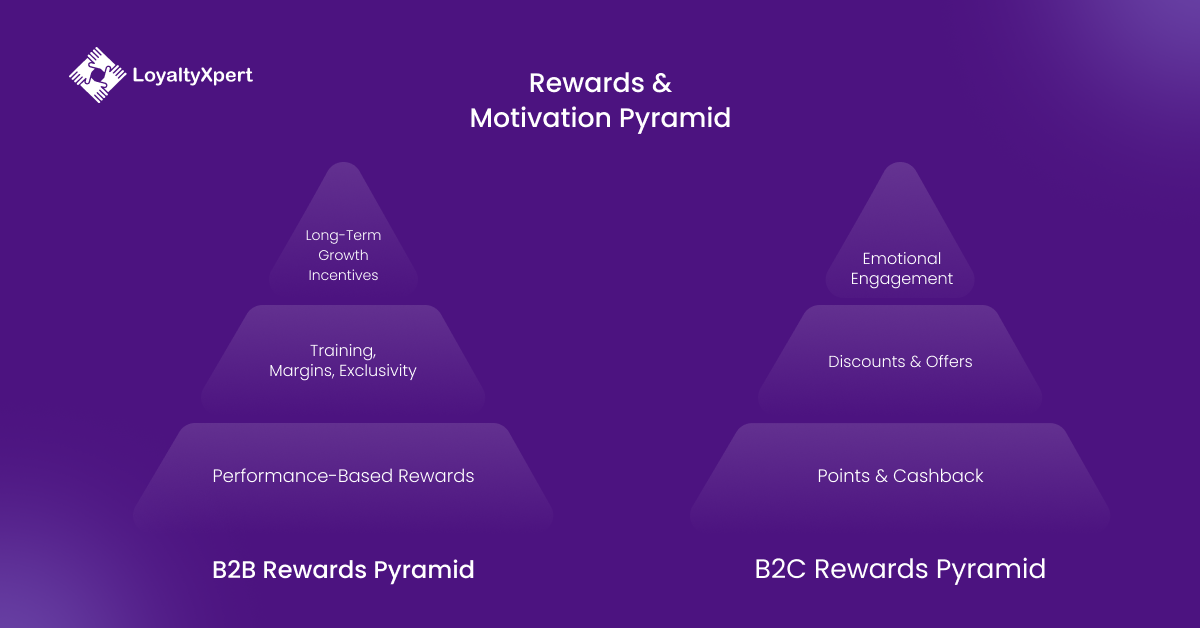
In contrast, B2C reward programs emphasize instant gratification and emotional appeal. Enabled by b2c loyalty program software, rewards such as discounts, bonus points, and early access are delivered through mobile apps, push notifications, and QR codes, creating engaging digital loyalty experiences.
10. Personalization
Personalization in B2B customer loyalty programs is account- or role-based, using insights like purchase volume, partner performance, and engagement history.
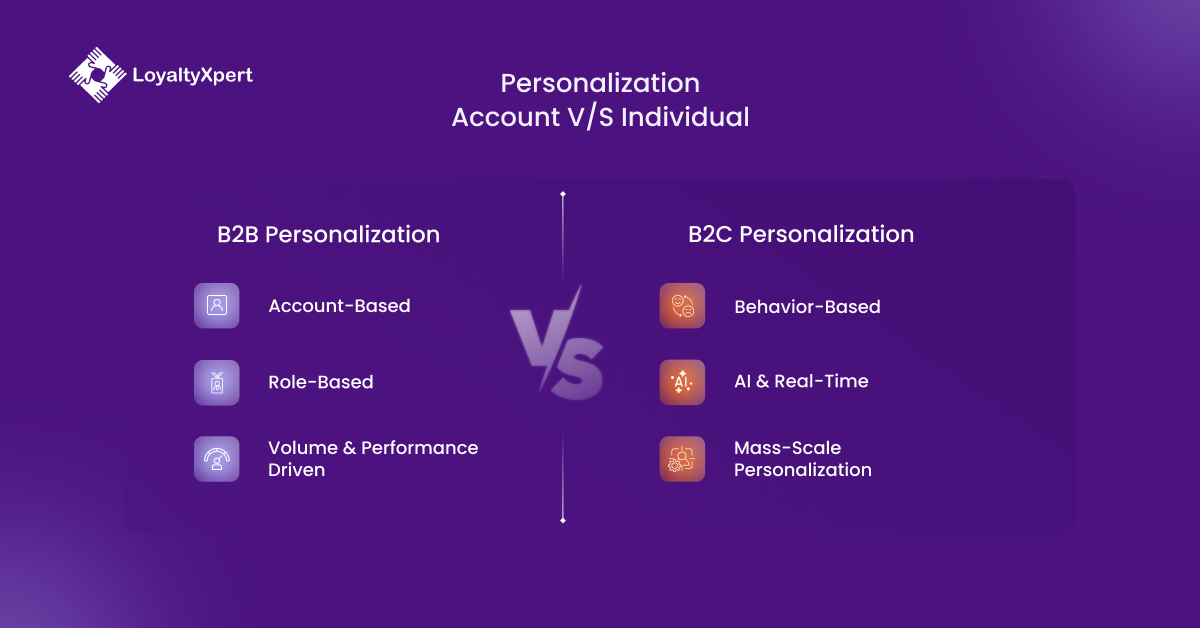
For B2C loyalty programs, personalization is AI-driven and scaled across large audiences. Brands use behavior and transaction data to deliver relevant offers in real time, highlighting a key difference in B2B vs B2C customer retention strategies.
11. Lead generation
B2C loyalty programs offer a huge scope for generating new leads and collecting valuable customer data as they incentivize target customers to enroll and enter their contact information. B2B loyalty programs, however, provide limited scope for lead generation as the vendors already have their client contact information.
12. Role of Technology & Platforms
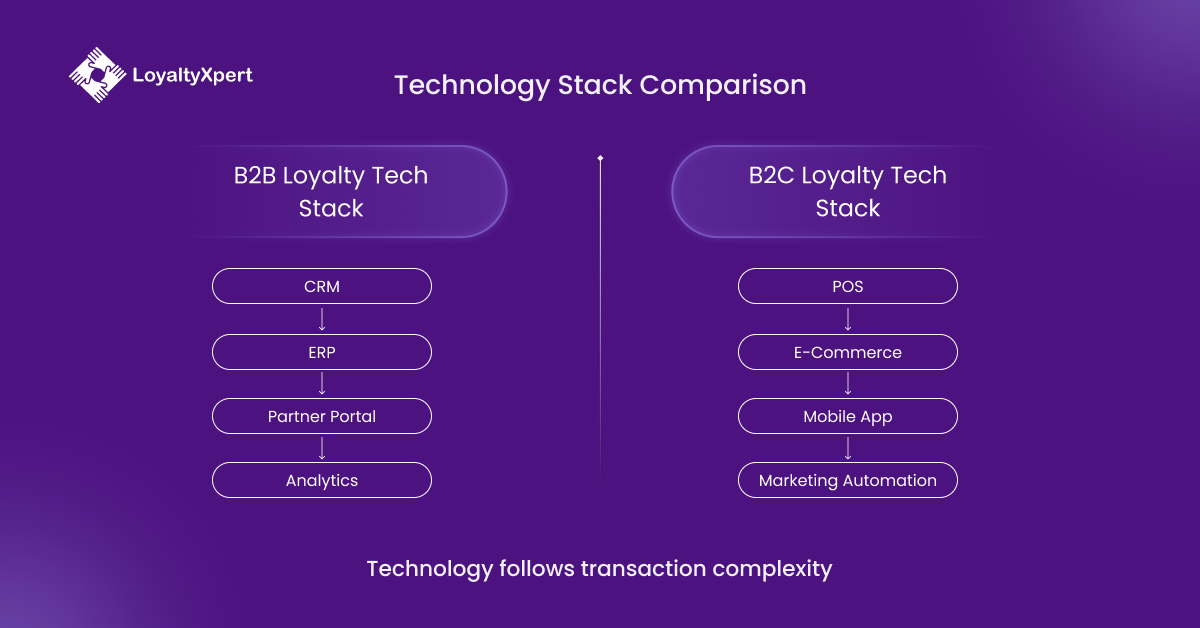
Technology plays a defining role in how a B2B Loyalty Program and a B2C Loyalty Program are designed, managed, and scaled. While both rely on digital tools, their technology needs differ significantly.
A. Loyalty management platforms & automation
B2B customer loyalty programs use b2b loyalty program software to automate partner onboarding, performance tracking, approvals, and long-term reward cycles. In contrast, b2c loyalty program software focuses on high-volume automation—instant points, real-time offers, and automated customer engagement.
B. Mobile apps vs self-service portals
B2C loyalty programs are largely app-driven, offering seamless access to rewards, offers, and notifications. B2B loyalty programs rely more on secure self-service portals where partners track targets, claims, and incentives.
C. Integration with CRM/ERP
B2B reward programs require deep CRM and ERP integration to align loyalty with sales data, invoices, and account performance. B2C programs typically integrate with POS, eCommerce, and marketing platforms.
D. Tracking, analytics, and reporting
B2B vs B2C customer retention also differs in analytics. B2B dashboards focus on account growth and partner contribution, while B2C dashboards track engagement, frequency, and redemption behavior.
E. Importance of loyalty software for business
Choosing the right loyalty software for business ensures scalability, personalization, and measurable ROI—especially as loyalty programs in India in B2B and B2C become more digital and data-driven.
💡 Fun Fact
B2B loyalty platforms are built to manage fewer users with complex workflows, while B2C loyalty platforms are designed to engage millions of users instantly.
Conclusion
Choosing between a B2B Loyalty Program and a B2C Loyalty Program is not about which model is better—it’s about which one aligns with your audience, buying behavior, and growth goals. As this blog highlights, B2B and B2C customer loyalty programs differ across scale, rewards, communication, personalization, and technology. In today’s digital-first landscape, success depends on using the right loyalty software for business to deliver data-driven, personalized, and measurable outcomes.
Modern loyalty is no longer reactive. Businesses that leverage advanced b2b loyalty program software or b2c loyalty program software can build stronger relationships, improve retention, and drive long-term value—especially as loyalty programs in India continue to evolve.
This is where LoyaltyXpert helps you stay ahead. We design and manage scalable B2B and B2C loyalty programs powered by intelligent technology and actionable insights.
Contact us to discuss your loyalty goals, or book a demo to see how LoyaltyXpert can transform your loyalty strategy into a powerful growth engine.